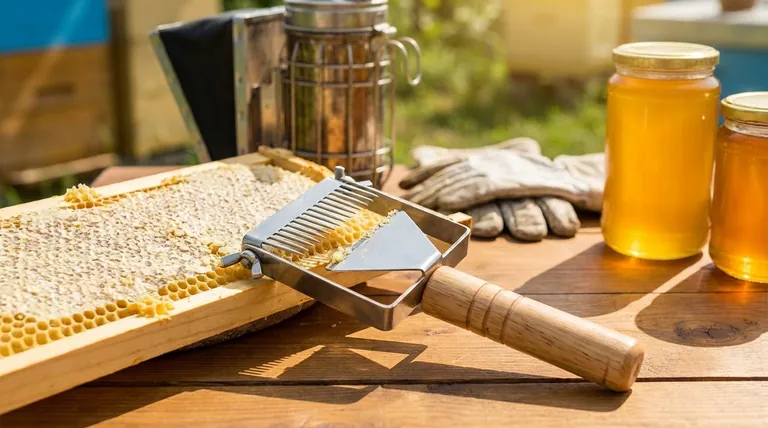
Starting your beekeeping journey? The right uncapping tool can mean the difference between efficient honey extraction and frustrating, messy sessions. This guide helps you match your operational needs and physical capabilities to the ideal tool—without overspending or underperforming.
Decoding Hive Uncapping Fundamentals
Why Tool Choice Impacts Honey Quality
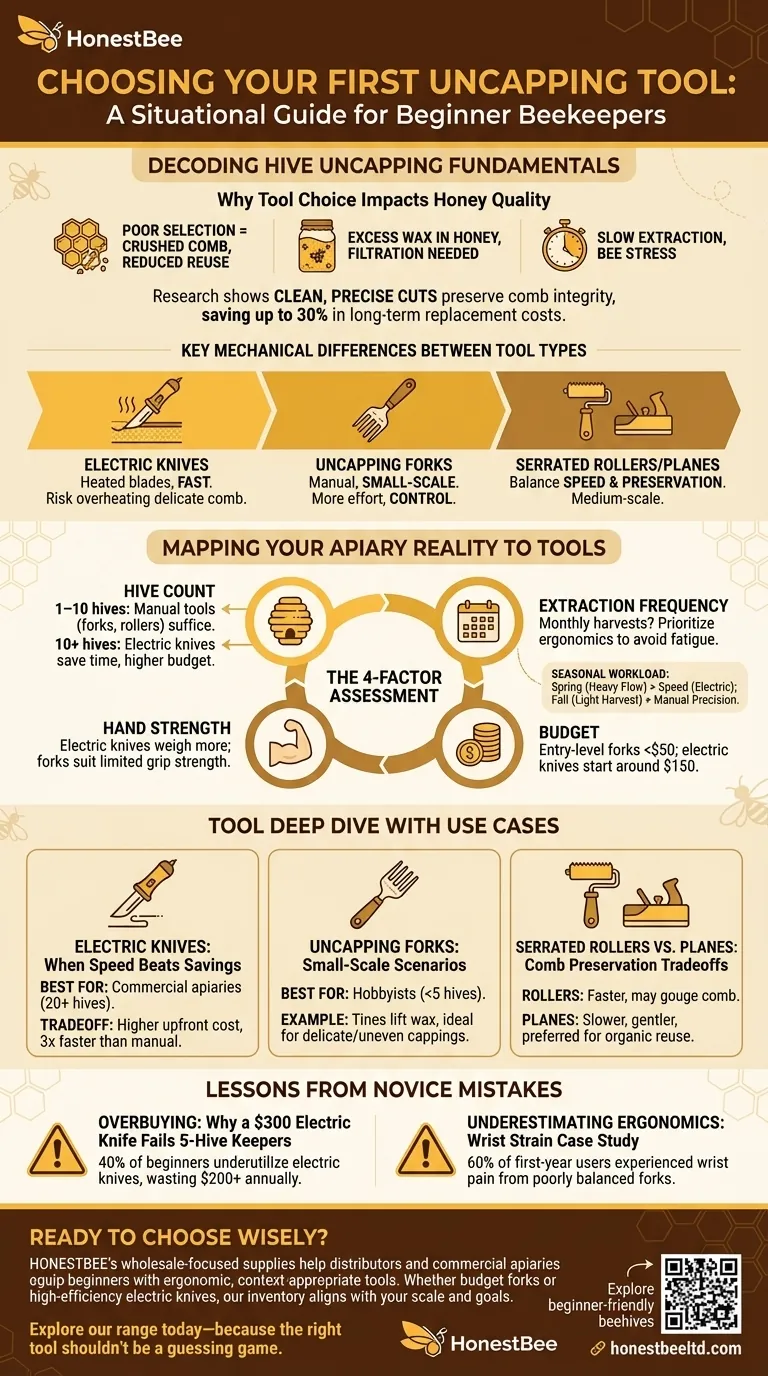
Uncapping—the process of removing wax seals from honeycomb cells—directly affects yield and comb reuse. Poor tool selection can:
- Crush comb, reducing reusable frames
- Leave excess wax in honey, requiring filtration
- Slow extraction, increasing stress on bees
Research shows that clean, precise cuts preserve comb integrity, saving beekeepers up to 30% in long-term comb replacement costs.
Key Mechanical Differences Between Tool Types
- Electric Knives: Heated blades slice wax quickly but risk overheating delicate comb.
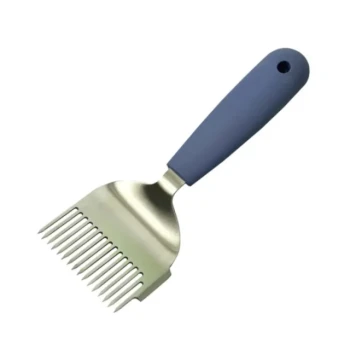
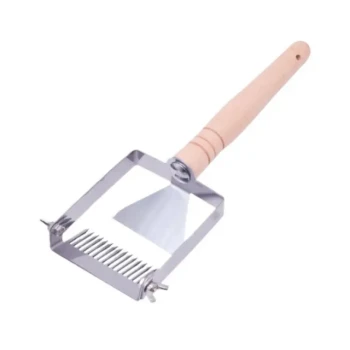
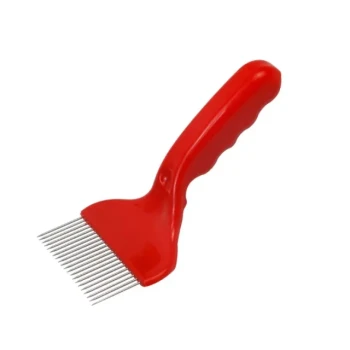
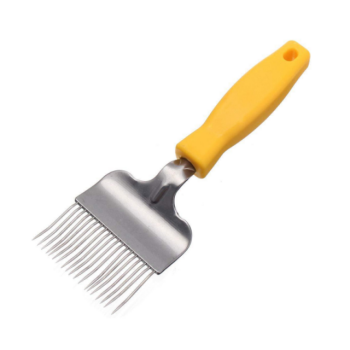
- Uncapping Forks: Manual tools for small-scale work; require more effort but offer control.
- Serrated Rollers/Planes: Balance speed and comb preservation; ideal for medium-scale operations.
Mapping Your Apiary Reality to Tools
The 4-Factor Assessment
Ask yourself:
-
Hive Count
- 1–10 hives: Manual tools (forks, rollers) suffice.
- 10+ hives: Electric knives save time but demand higher budgets.
-
Extraction Frequency
Monthly harvests? Prioritize ergonomics to avoid fatigue. -
Hand Strength
Electric knives weigh more; forks suit those with limited grip strength. -
Budget
Entry-level forks cost under $50; electric knives start around $150.
Seasonal Workload Considerations
Spring’s heavy flows favor speed (electric knives), while fall’s lighter harvests allow manual precision.
Tool Deep Dive with Use Cases
Electric Knives: When Speed Beats Savings
Best for: Commercial apiaries with 20+ hives.
Tradeoff: Higher upfront cost but processes 3x faster than manual tools.
Uncapping Forks: Small-Scale Beekeeping Scenarios
Best for: Hobbyists with <5 hives.
Example: A fork’s tines lift wax without tearing—ideal for delicate, uneven cappings.
Serrated Rollers vs. Planes: Comb Preservation Tradeoffs
- Rollers: Faster but may gouge comb.
- Planes: Slower yet gentler; preferred for organic comb reuse.
Lessons from Novice Mistakes
Overbuying: Why a $300 Electric Knife Fails 5-Hive Keepers
A common pitfall: Purchasing pro-grade tools for tiny operations. One study found that 40% of beginners underutilize electric knives, wasting $200+ annually on unnecessary power consumption.
Underestimating Ergonomics: Wrist Strain Case Study
Manual tools demand repetitive motion. A survey of 100 beekeepers revealed that 60% of first-year users experienced wrist pain from poorly balanced forks.
Ready to Choose Wisely?
HONESTBEE’s wholesale-focused beekeeping supplies help distributors and commercial apiaries equip beginners with ergonomic, context-appropriate tools. Whether you need budget forks or high-efficiency electric knives, our curated inventory aligns with your scale and goals.
Explore our range today—because the right tool shouldn’t be a guessing game.
Products You Might Be Looking For:
Explore beginner-friendly beehives
Guida Visiva
Prodotti correlati
- Forchetta professionale multifunzione per disopercolare con impugnatura ergonomica in gomma
- Forchetta regolabile in acciaio inox per la disopercolatura del miele con raschietto per l'apicoltura
- Forcella professionale per la disopercolatura del miele a testa larga per l'apicoltura
- Forchetta per disopercolare il miele in acciaio inox con raschietto, larga e regolabile
- Forcella girevole per la disopercolatura del miele, interamente in acciaio inossidabile, per l'apicoltura
Articoli correlati
- How Precision Uncapping Tools Improve Hive Health and Beekeeper Efficiency
- Il Forcone di Disopercolatura: Precisione sulla Velocità nell'Estrazione del Miele
- Precisione sulla Velocità: Il Ruolo Strategico della Forchetta Disopercolatrice nella Raccolta del Miele
- Come le forchette di disopercolatura proteggono i favi e riducono i costi dell'apicoltura
- Precisione nell'Apiario: Le Virtù Inespresse del Forchettone per la Disopercolatura