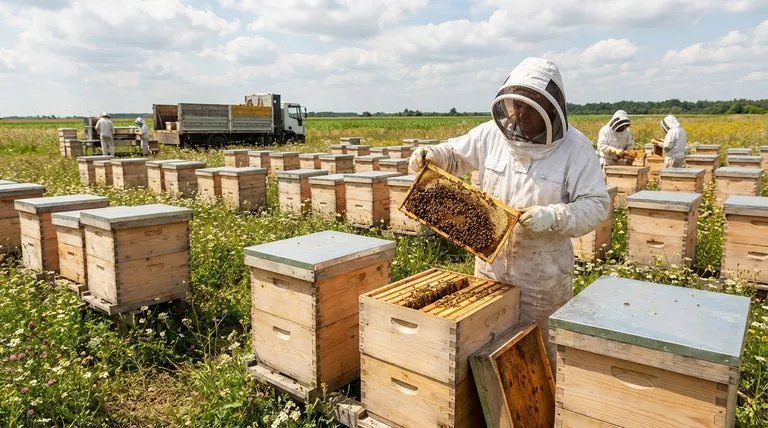
For commercial beekeepers, maximizing honey yield isn’t just about colony health—it’s about leveraging engineering and management systems that align with bee behavior. The Langstroth hive’s design and operational advantages make it the undisputed leader for high-volume honey production. Here’s how its scientific blueprint, swarm control mechanisms, and harvest-focused workflows translate to 40–100% higher yields compared to Top-Bar or Warre hives.
Langstroth Hive Design: A Scientific Blueprint for Honey Maximization
The "Bee Space" Principle: Precision Engineering for Productivity
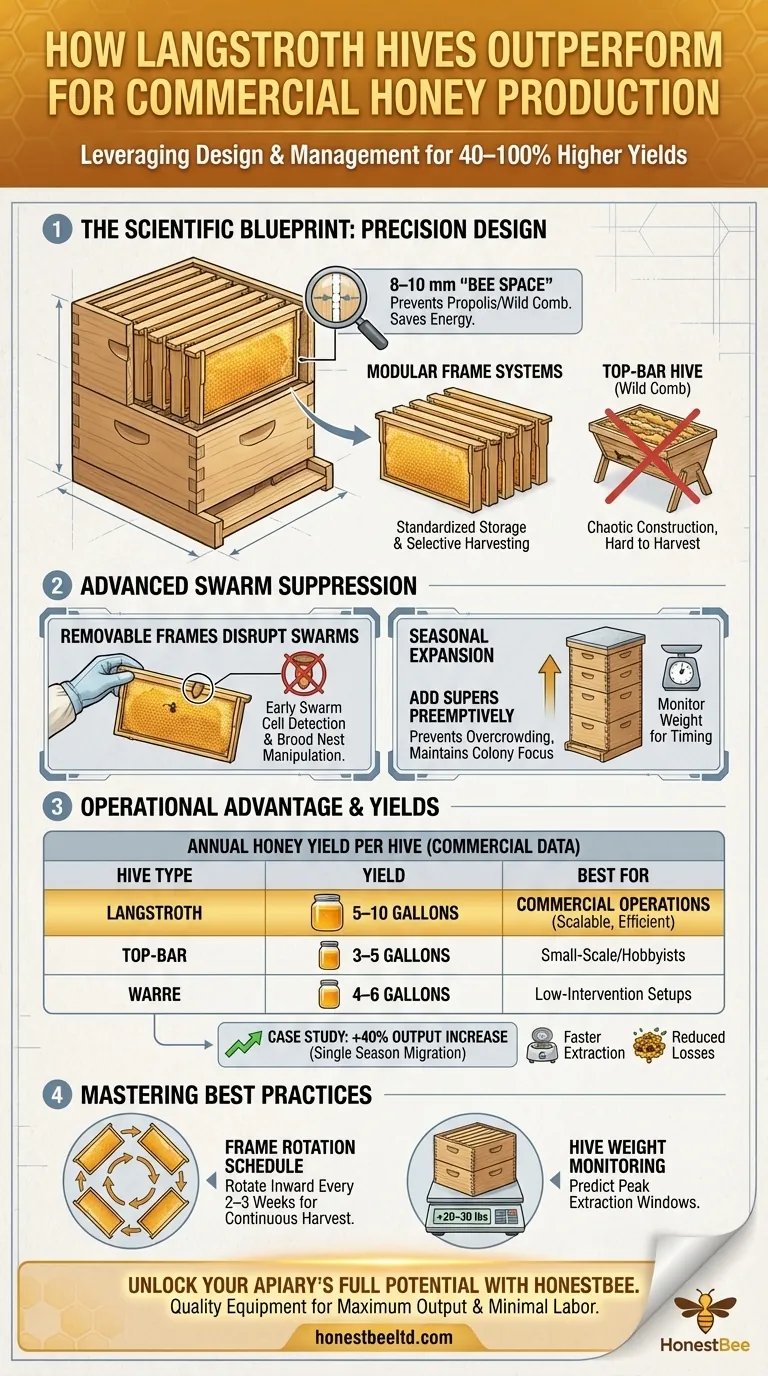
Langstroth hives are built around the 8–10 mm "bee space"—a gap bees naturally avoid filling with propolis or comb. This allows:
- Modular frame systems that prevent chaotic comb construction, saving bees’ energy for honey production.
- Effortless hive inspections without damaging comb, reducing stress on colonies.
Modular Frames vs. Wild Comb: Accelerating Honey Storage
Unlike Top-Bar hives (where bees build free-hanging comb) or Warre hives (with fixed vertical bars), Langstroth’s removable frames:
- Standardize honey storage, enabling bees to focus on filling uniform cells instead of building structural comb.
- Enable selective harvesting, so beekeepers extract only ripe honey while leaving brood areas undisturbed.
Swarm Suppression Strategies in Langstroth Systems
How Removable Frames Disrupt Swarm Cell Construction
Swarming—a colony’s natural reproduction method—can slash honey yields by 50% or more. Langstroth hives counteract this through:
- Early swarm cell detection: Beekeepers can quickly locate and remove queen cells during routine frame inspections.
- Brood nest manipulation: Shifting frames to redistribute brood disrupts the colony’s swarming impulse.
Seasonal Hive Expansion Techniques to Maintain Colony Focus
Langstroth’s stackable design lets beekeepers:
- Add supers (honey storage boxes) preemptively during nectar flows, preventing overcrowding that triggers swarming.
- Monitor hive weight to gauge honey accumulation and time expansions optimally.
Operational Advantages Over Alternative Hive Types
Honey Yield per Hive: Langstroth vs. Top-Bar vs. Warre
Data from commercial apiaries shows stark differences:
| Hive Type | Annual Yield per Hive | Best For |
|---|---|---|
| Langstroth | 5–10 gallons | Commercial operations |
| Top-Bar | 3–5 gallons | Small-scale/hobbyists |
| Warre | 4–6 gallons | Low-intervention setups |
Key takeaway: Langstroth’s scalability and efficiency make it the only viable choice for beekeepers selling wholesale.
Case Study: Commercial Apiary’s 40% Output Increase After Hive Migration
One Midwestern apiary documented higher yields within a single season after switching from Top-Bar to Langstroth, attributing success to:
- Faster honey extraction (standardized frames fit commercial centrifuges).
- Reduced colony losses from better swarm control.
Mastering Langstroth-Specific Best Practices
Frame Rotation Schedules for Continuous Harvest
To maintain honey purity and volume:
- Rotate outer frames inward every 2–3 weeks during peak flow, ensuring even comb utilization.
- Prioritize harvesting from upper supers first, where bees store surplus honey.
Hive Weight Monitoring to Identify Peak Extraction Windows
Weighing hives weekly helps:
- Predict harvest timing: A 20–30 lb gain in 7 days signals strong nectar flow.
- Prevent overextension: Colonies adding <5 lb/week may need supplemental feeding.
Unlock Your Apiary’s Full Potential with HONESTBEE
Langstroth hives are the backbone of commercial beekeeping—but their advantages only materialize with quality equipment and disciplined management. HONESTBEE equips large-scale apiaries and distributors with durable, precision-engineered hive components designed to maximize honey output while minimizing labor.
Ready to upgrade your operation? Explore HONESTBEE’s wholesale solutions today and harness the full power of Langstroth efficiency.
Guida Visiva
Prodotti correlati
- Arnie Langstroth ad alte prestazioni per l'apicoltura professionale globale
- Langstroth Honey Bee Box Cassette per alveari a profondità diverse
- Scatole per alveari Langstroth australiane per l'apicoltura all'ingrosso
- Alveare a barre orizzontali di tipo Langstroth lungo per la vendita all'ingrosso
- Fondo solido in legno di pino australiano Langstroth Bottom Board per l'ingrosso
Articoli correlati
- Flow Hive vs. Langstroth: When Does the Premium Price Deliver Real Savings?
- Come scegliere tra le arnie Top Bar e Langstroth per un'apicoltura senza problemi
- Come il design dell'arnia Langstroth ottimizza la crescita della colonia di api e la produzione di miele
- Arnie Langstroth a 8 e a 10 telai: Una guida pratica per gli apicoltori
- Mastering Seasonal Langstroth Hive Management: Timelines, Techniques, and Troubleshooting













