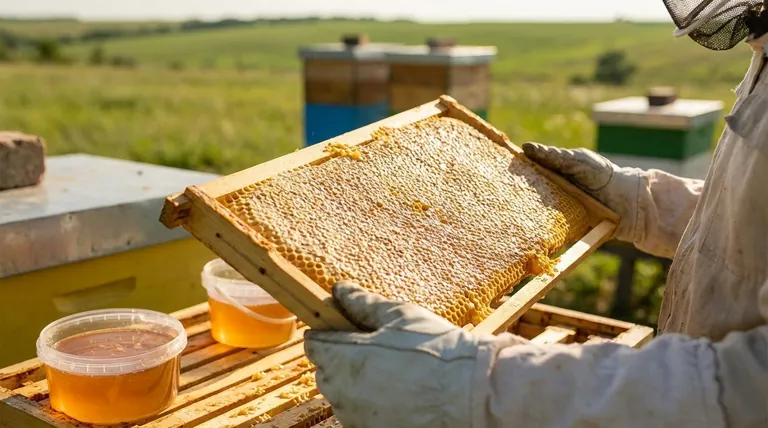
For commercial beekeepers, every drop of honey counts—but what if the secret to higher yields isn't just about the bees? Research shows that damaged wax foundations force colonies to divert over 10% of their honey production into wax regeneration. This article reveals three proven methods used by top apiaries to protect comb structures and maximize harvests.
The High Cost of Beeswax Regeneration
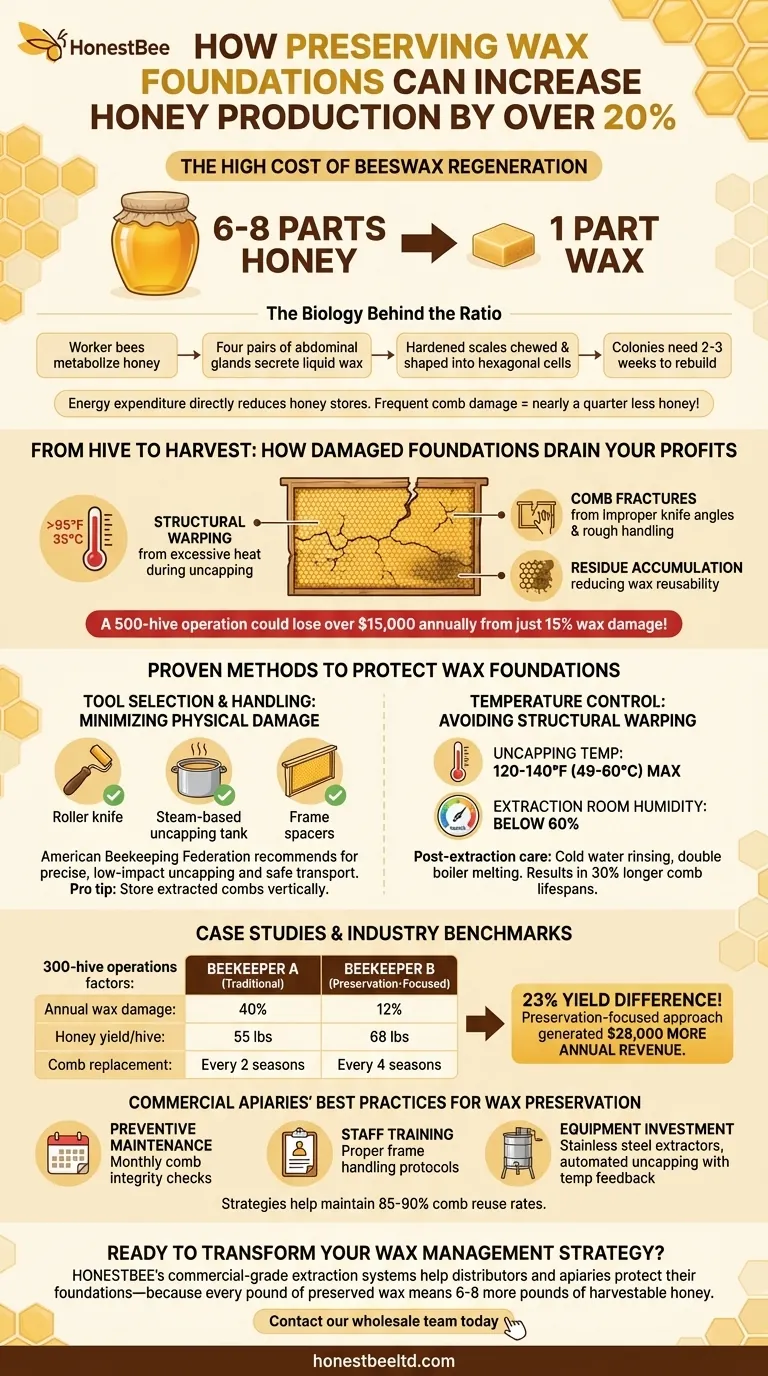
Why 10 kg of Honey = 1 kg of Wax: The Biology Behind the Ratio
Worker bees metabolize honey at an astonishing rate to produce wax—approximately 6-8 parts honey are consumed to create 1 part wax. The process involves:
- Four pairs of abdominal glands secreting liquid wax
- Hardened scales being chewed and shaped into hexagonal cells
- Colonies requiring 2-3 weeks to rebuild fully damaged combs
This energy expenditure directly reduces available honey stores. One study found apiaries with frequent comb damage produced nearly a quarter less honey than counterparts maintaining intact foundations.
From Hive to Harvest: How Damaged Foundations Drain Your Profits
Common extraction pitfalls include:
- Structural warping from excessive heat (>95°F/35°C) during uncapping
-
Comb fractures caused by:
- Improper knife angles during uncapping
- Rough handling of frames
- Residue accumulation reducing wax reusability
A commercial operation with 500 hives could lose over $15,000 annually from just 15% wax damage—equivalent to 1-2 full honey rotations.
Proven Methods to Protect Wax Foundations
Tool Selection and Handling: Minimizing Physical Damage
The American Beekeeping Federation recommends:
✔ Roller knives for precise, low-impact uncapping
✔ Steam-based uncapping tanks (vs. traditional hot knives)
✔ Frame spacers during transport to prevent collisions
Pro tip: Store extracted combs vertically in climate-controlled rooms to prevent deformation.
Temperature Control During Extraction: Avoiding Structural Warping
Optimal preservation requires:
- Uncapping temperature: 120-140°F (49-60°C) maximum
- Extraction room humidity: Below 60% to prevent softening
-
Post-extraction care:
- Cold water rinsing for honey residue removal
- Double boiler melting for wax recovery
Commercial operators report 30% longer comb lifespans using these methods.
Case Studies and Industry Benchmarks
Beekeeper A vs. Beekeeper B: A 23% Yield Difference Explained
Two 300-hive operations showed stark contrasts:
| Metric | Beekeeper A (Traditional) | Beekeeper B (Preservation-Focused) |
|---|---|---|
| Annual wax damage | 40% | 12% |
| Honey yield/hive | 55 lbs | 68 lbs |
| Comb replacement | Every 2 seasons | Every 4 seasons |
The preservation-focused approach generated $28,000 more annual revenue despite identical bee stock.
Commercial Apiaries’ Best Practices for Wax Preservation
Top performers combine:
- Preventive maintenance: Monthly comb integrity checks
- Staff training: Proper frame handling protocols
-
Equipment investment:
- Stainless steel extractors with gentle baskets
- Automated uncapping systems with temperature feedback
These strategies help large-scale operations maintain 85-90% comb reuse rates across multiple seasons.
Ready to transform your wax management strategy? HONESTBEE's commercial-grade extraction systems help distributors and apiaries protect their foundations—because every pound of preserved wax means 6-8 more pounds of harvestable honey. [Contact our wholesale team today] to discuss customized solutions for your operation.
Guida Visiva
Prodotti correlati
- Stampo per fondotinta in cera d'api stile quaderno Stampo per fondotinta in cera
- Cera d'api macchina stampa goffratore cera fondazione stampo stampante ape alveare attrezzature rendendo foglio
- Stampo di fondazione in cera d'api in silicone colorato per l'apicoltura
- Macchina di fondazione manuale a pettine di cera d'api Mulino di fondazione di cera Macchina di goffratura
- Economia manuale cera d'api goffratura Mill cera fondazione macchina rullo
Articoli correlati
- How to Choose and Use Budget-Friendly Tools for Durable Beeswax Foundations
- Come le Fondazioni di Cera d'Api Migliorano la Salute delle Colonie e l'Efficienza dell'Apicoltura
- Come scegliere lo stampo giusto per i vostri progetti di cera d'api:Una guida pratica
- L'Architettura Invisibile: Come la Cera Fondamentale Ingegnerizza l'Economia di un Alveare
- La Tassa Nascosta dell'Alveare: Come i Favi Artificiali Riprogettano l'Economia di una Colonia







