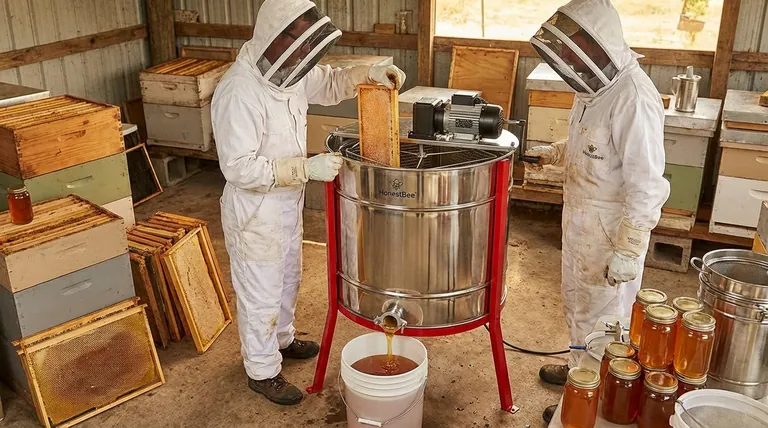
Whether you're a small-scale beekeeper or manage a commercial operation, selecting the optimal honey processing method impacts product quality, operational efficiency, and profitability. This guide breaks down key techniques—from basic straining to industrial bulk processing—helping you align methods with your production scale, budget, and market demands.
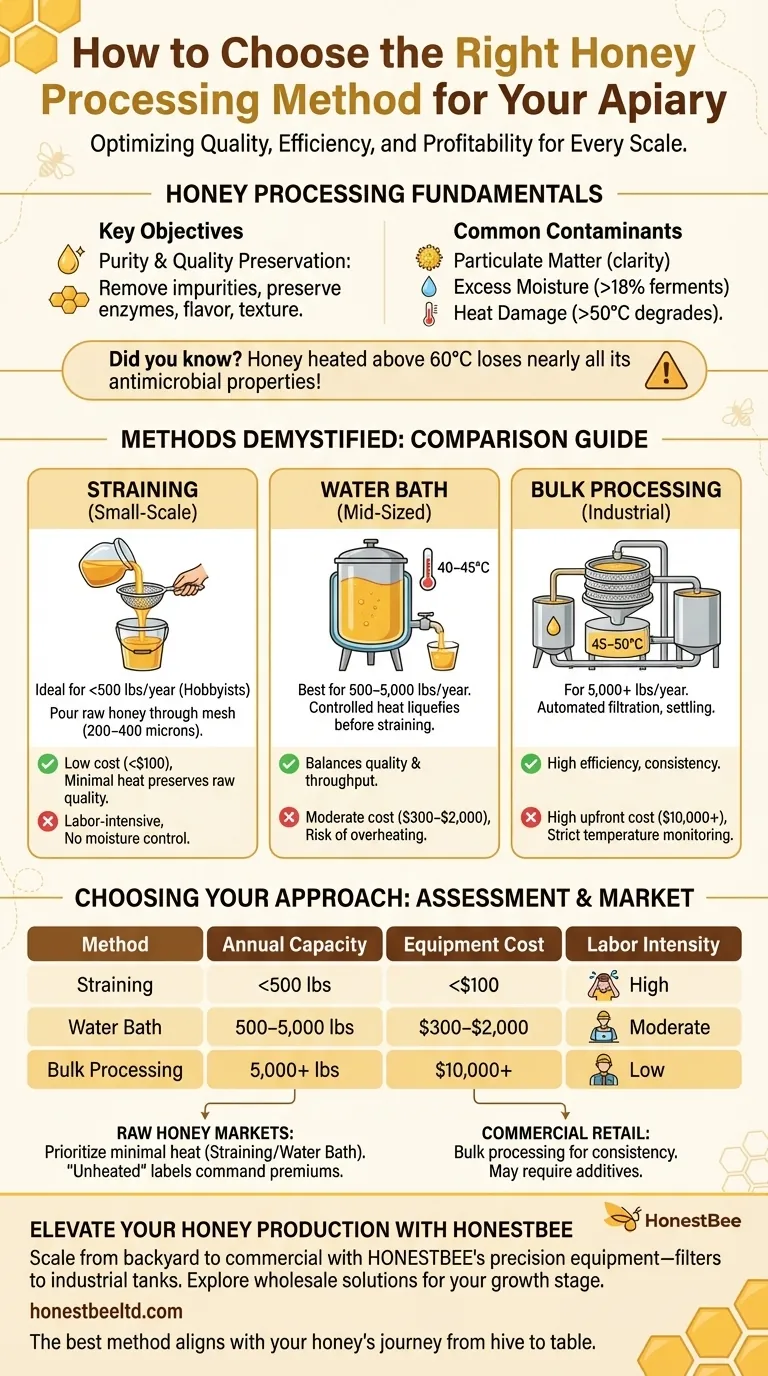
Honey Processing Fundamentals
Key Objectives: Purity and Quality Preservation
The primary goal of honey processing is to remove impurities (like wax particles or bee debris) while preserving natural enzymes, flavor, and texture. Over-processing can degrade quality, while under-processing may lead to premature crystallization or contamination.
Common Contaminants and Their Impact
- Particulate Matter: Pollen, wax, or propolis fragments affect clarity and shelf appeal.
- Excess Moisture: Honey with water content above 18% ferments faster and crystallizes unevenly.
- Heat Damage: Temperatures exceeding 50°C destroy beneficial enzymes like glucose oxidase.
Did you know? Research shows that honey heated above 60°C loses nearly all its antimicrobial properties.
Methods Demystified
Straining: Simplicity for Small-Scale Apiaries
Ideal for hobbyists or apiaries producing under 500 lbs annually, straining involves pouring raw honey through a mesh filter (typically 200–400 microns) to remove debris.
Pros:
- Low equipment costs (basic nylon filters cost under $50)
- Minimal heat exposure preserves raw honey qualities
Cons:
- Labor-intensive for larger batches
- Doesn’t address moisture control
Water Bath: Balancing Cost and Thermal Control
A step up from straining, this method uses controlled heat (40–45°C) in a water jacket to liquefy crystallized honey before straining.
Best for: Mid-sized operations (500–5,000 lbs/year) needing to balance quality and throughput.
Trade-offs:
- Moderate equipment investment (commercial-grade baths start around $300)
- Risk of overheating if unmonitored
Bulk Processing: Industrial Efficiency Trade-offs
For large apiaries or distributors handling 5,000+ lbs annually, bulk systems automate filtration and settling.
How It Works:
- Honey flows through concentric sieves (finest mesh removes particles as small as 100 microns).
- Heated to 45–50°C in a sump tank to reduce viscosity.
- Settles for 3+ days to allow impurities to surface before packing.
Considerations:
- Higher upfront costs (industrial systems can exceed $10,000)
- Faster processing but requires strict temperature monitoring to prevent quality loss
Choosing Your Approach
Assessing Production Volume and Budget
| Method | Annual Capacity (lbs) | Equipment Cost | Labor Intensity |
|---|---|---|---|
| Straining | <500 | <$100 | High |
| Water Bath | 500–5,000 | $300–$2,000 | Moderate |
| Bulk Processing | 5,000+ | $10,000+ | Low |
Quality Standards by Market
- Raw Honey Markets: Prioritize minimal heat (straining or low-temp water baths).
- Commercial Retail: Bulk processing meets consistency demands but may require additives to slow crystallization.
Pro Tip: Honey destined for health-food stores often commands higher prices when labeled "unheated" or "raw."
Elevate Your Honey Production with HONESTBEE
Whether you're scaling from backyard hives to commercial volumes or optimizing for premium quality, HONESTBEE’s beekeeping equipment—from precision filters to industrial settling tanks—helps you process honey efficiently without compromising purity. Explore our wholesale solutions today to match your apiary’s growth stage with the right tools.
Final Thought: The best processing method isn’t about the most advanced technology—it’s about what aligns with your honey’s journey from hive to table.
Guida Visiva
Prodotti correlati
- Miele che concentra e filtra la capacità della macchina 2T del deumidificatore di filtrazione per il miele
- Pesante macchina per la lavorazione del miele in acciaio inox serbatoio di decristallizzazione
- Miele doppia parete riscaldamento agitazione omogeneizzatore macchina di miscelazione con varie capacità
- Attrezzatura elettrica per purificare la macchina per il filtraggio del miele a doppia parete per l'impianto di lavorazione del miele
- Economia miele omogeneizzatore miscelatore e macchina di fusione per l'apicoltura
Articoli correlati
- Oltre il Colino: L'Ingegneria della Fiducia nella Produzione Commerciale di Miele
- Oltre la purezza: come le macchine filtranti per miele creano fiducia su larga scala
- Il Collo di Bottiglia Appiccicoso: Perché la Tua Filtrazione del Miele Fallisce e Come Risolverla Definitivamente
- Come le Macchine per la Filtrazione del Miele Preservano la Qualità Naturale e Aumentano i Profitti degli Apicoltori
- Dal Caos alla Chiarezza: Fisica e Psicologia della Filtrazione del Miele













