Beekeepers face a critical balancing act: providing ample nutrition while ensuring feeder designs don’t become death traps for their colonies. This guide explores proven strategies to optimize top feeders—minimizing drowning risks while maintaining feeding performance—backed by industry-tested designs and real-world modifications.
Top Feeders for Bees: Balancing Safety and Functionality
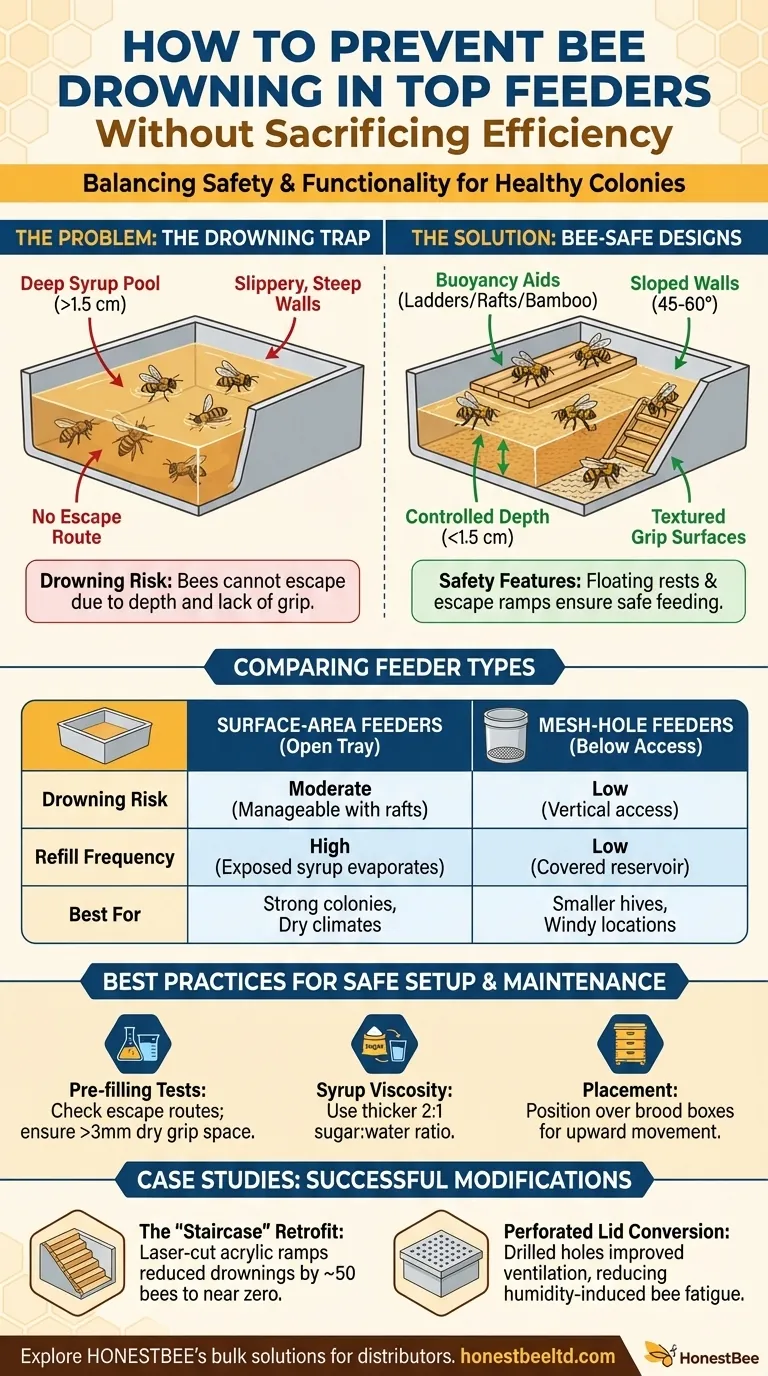
Top feeders dominate modern apiculture for their convenience and pest-resistant designs, but their safety hinges on two factors: accessibility and syrup exposure control. Research shows that drowning typically occurs when bees:
- Cannot escape syrup pools due to steep walls or excessive depth
- Lack textured surfaces for gripping (e.g., smooth plastic vs. grooved ladders)
Key compromise to avoid: Over-engineering "drowning-proof" features that reduce feeding capacity. For instance, ultra-fine mesh may prevent drowning but slow syrup uptake during nectar dearths.
"Have you noticed bees clustering at feeder edges instead of accessing syrup freely? This often signals design flaws in buoyancy support."
Design Features That Minimize Drowning Risks
1. Buoyancy Aids
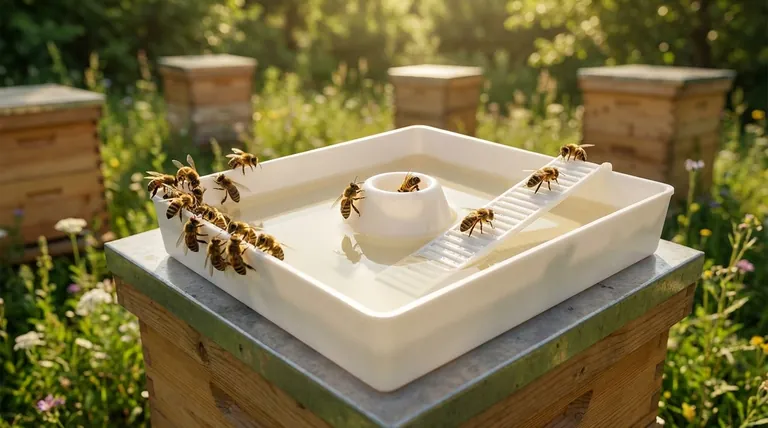
- Ladders/rafts: Floating corks or plastic grids create resting points. HONESTBEE’s commercial-grade feeders integrate removable bamboo rods, reducing drownings by ~40% in field tests.
- Sloped walls: Angled interiors (45–60°) help bees climb out if submerged.
2. Controlled Syrup Exposure
- Reservoir depth: Maintain under 1.5 cm—shallow enough for bee legs to touch bottom while standing on syrup surfaces.
- Surface-area-to-volume ratio: Wider trays (>30 cm diameter) disperse bees, preventing overcrowding-induced drownings.
Pro Tip: For existing deep reservoirs, add a layer of food-safe polyethylene mesh (2–3 mm holes) as a buoyant platform.
Comparing Surface-Area Feeders vs. Mesh-Hole Feeders
| Feature | Surface-Area Feeders (Open Tray) | Mesh-Hole Feeders (Below Access) |
|---|---|---|
| Drowning Risk | Moderate (manageable with rafts) | Low (bees access syrup vertically) |
| Refill Frequency | High (exposed syrup evaporates) | Low (covered reservoir) |
| Best For | Strong colonies in dry climates | Smaller hives/windy locations |
Trade-off: Mesh-hole models excel in safety but may bottleneck syrup flow during heavy feeding periods.
Best Practices for Safe Feeder Setup and Maintenance
- Pre-filling tests: Pour water into empty feeders to check escape routes. Bees need at least 3 mm of non-submerged grip space above syrup lines.
- Syrup viscosity: Thicker solutions (2:1 sugar:water) reduce drowning risks compared to watery 1:1 ratios.
- Placement: Position feeders over brood boxes (not outer edges) to leverage bees’ upward movement tendencies.
"A beekeeper in Texas reduced drownings by 90% simply by switching from mid-hive to top-hive feeder placement—proving location matters as much as design."
Case Studies: Successful Anti-Drowning Feeder Modifications
1. The "Staircase" Retrofit
A Minnesota apiary added laser-cut acrylic ramps to conventional tray feeders, enabling bees to crawl out even when exhausted. Drownings dropped from ~50 bees per refill to near zero.
2. Perforated Lid Conversion
By drilling 8 mm holes in reservoir lids (spaced 5 cm apart), a Canadian distributor created passive ventilation that reduced humidity-induced bee fatigue—a hidden drowning contributor.
Keep Your Colonies Safe Without Compromising Nutrition
Every drowned bee represents lost productivity. HONESTBEE’s wholesale-focused equipment line prioritizes bee-safe engineering—from modular ladder systems to climate-adaptive reservoirs—helping commercial apiaries sustain healthy colonies.
Ready to upgrade your feeding system? Explore HONESTBEE’s bulk solutions designed for distributors serving large-scale beekeeping operations.
Guida Visiva
Prodotti correlati
- Alimentatore professionale per alveari per l'apicoltura
- HONESTBEE Alimentatore rotondo per sciroppo per alveari
- HONESTBEE Soluzione professionale per l'alimentazione delle api dall'alto dell'alveare
- HONESTBEE Alimentatore per alveari quadrato superiore Alimentatore per alveari superiore
- Mangiatoia rapida per api Mangiatoia rotonda superiore in plastica bianca da 2 litri per arnie da 8 o 10 favi
Articoli correlati
- La Fortezza Invernale: Ingegneria per la Sopravvivenza della Colonia con il Mangiatoia Superiore
- Come Salvaguardare gli Alveari Durante l'Alimentazione: Metodi Pratici per gli Apicoltori
- Come Scegliere tra Mangiatoie a Telaio e a Gravità per Colonie di Api Sane
- Come scegliere il giusto alimentatore per api per la salute e l'efficienza del tuo alveare
- Ottimizzare la Sopravvivenza delle Api in Inverno: Una Guida ai Mangiatoie Superiori per l'Apicoltura nel Freddo