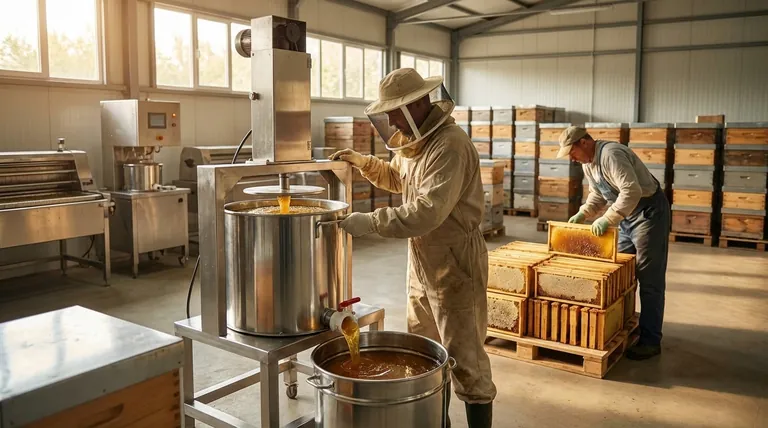
Modern beekeepers face a critical decision when scaling operations: how to extract honey efficiently without compromising quality or budget. This guide compares metal press extraction with centrifugal and crush-strain methods, providing actionable workflow optimizations for apiaries managing 50+ hives.
Metal Press Honey Extraction: High-Volume Processing Reimagined
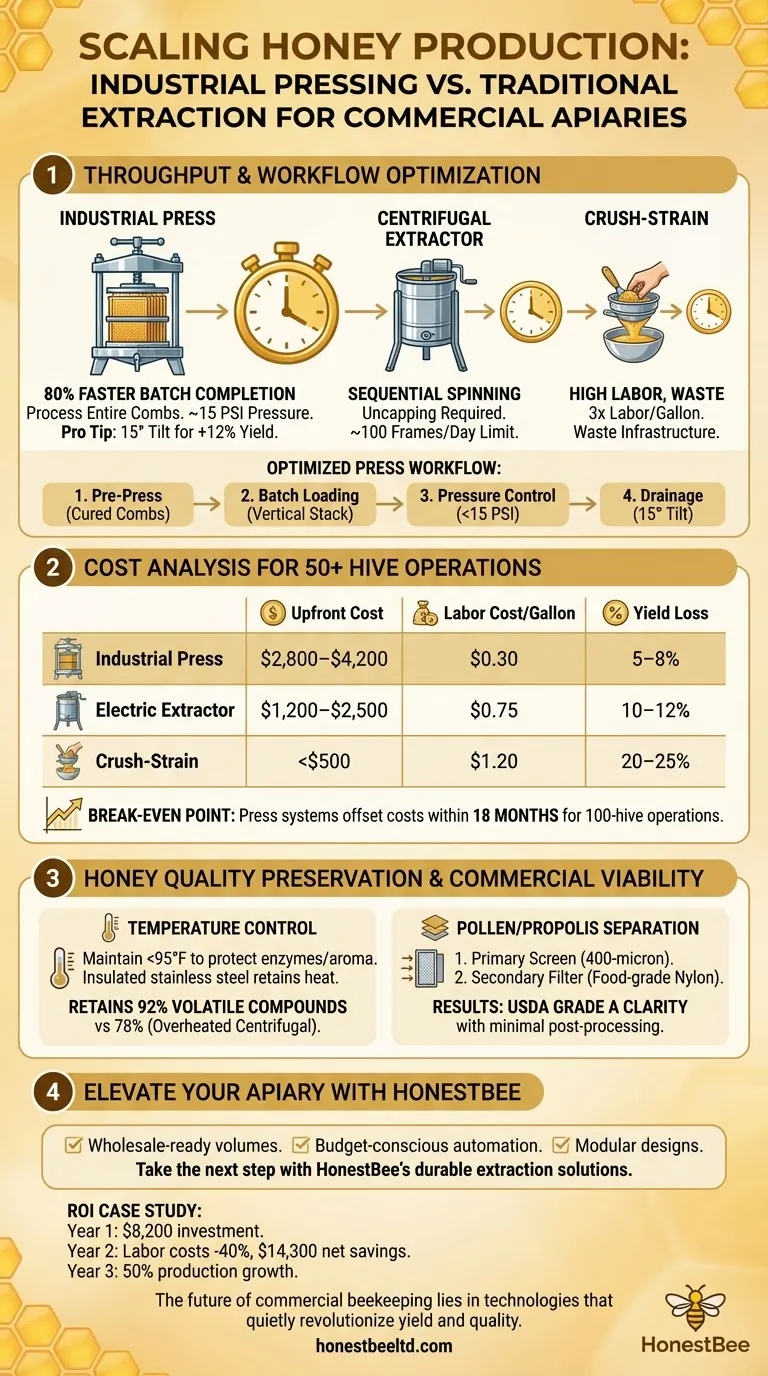
Throughput Comparison: Press vs Centrifugal vs Crush-Strain
Industrial presses outperform traditional methods in large-scale scenarios:
- Press systems process entire combs without frame-by-frame handling, achieving ~80% faster batch completion than centrifugal extractors.
- Centrifugal extractors (manual or electric) require uncapping and sequential spinning, limiting daily output to ~100 frames per worker.
- Crush-strain methods, while low-cost, waste comb infrastructure and demand 3× more labor per gallon.
Key Insight: For apiaries exceeding 50 hives, presses reduce extraction time by hours per batch, freeing staff for hive maintenance.
Press Operation Workflow Optimization
Maximize efficiency with these steps:
- Pre-press preparation: Use fully cured combs (18% moisture or less) to minimize residue.
- Batch loading: Stack combs vertically in the press cage to exploit gravity-assisted drainage.
- Pressure control: Gradually increase to ~15 PSI—exceeding this risks wax contamination.
Pro Tip: Tilt pressed combs at a 15° angle during drainage to improve yield by ~12%.
Cost Analysis for 50+ Hive Operations
| Method | Upfront Cost | Labor Cost/Gallon | Yield Loss |
|---|---|---|---|
| Industrial Press | $2,800–$4,200 | $0.30 | 5–8% |
| Electric Extractor | $1,200–$2,500 | $0.75 | 10–12% |
| Crush-Strain | <$500 | $1.20 | 20–25% |
Break-even point: Press systems offset higher initial costs within 18 months for 100-hive operations through labor savings.
Honey Quality Preservation: Industrial Methods Meet Artisan Standards
Temperature Control During Bulk Pressing
Heat management is critical:
- Maintain pressing temperatures below 95°F to protect enzymes and aroma compounds.
- Insulated stainless steel presses retain ambient heat better than plastic centrifugal tubs, reducing energy needs.
Research shows: Honey pressed at controlled temperatures retains 92% of volatile compounds versus 78% in overheated centrifugal runs.
Pollen/Propolis Separation Techniques
Industrial presses integrate filtration:
- Primary screen: 400-micron mesh removes wax debris.
- Secondary filter: Food-grade nylon captures pollen while allowing honey flow.
Result: Press-extracted honey achieves USDA Grade A clarity with minimal post-processing.
Commercial Viability: ROI and Long-Term Maintenance
Case Study: 100-Hive Apiary ROI Timeline
A Midwest apiary switching from electric extractors to presses documented:
- Year 1: $8,200 equipment investment + $1,100 training.
- Year 2: Labor costs dropped 40%, yielding $14,300 net savings.
- Year 3: Increased capacity allowed 50% production growth without new hires.
Sanitation Protocols for Repeated Press Use
Follow USDA-approved cleaning (referenced from HONESTBEE guidelines):
- Disassemble and boil steel components to soften wax.
- Scrape residue with food-safe paddles.
- Cold-water rinse solidifies remaining wax for easy removal.
Best practice: Sanitize presses every 10 batches to prevent microbial buildup.
Elevate Your Apiary’s Efficiency with HONESTBEE
For commercial beekeepers prioritizing scalability without sacrificing honey integrity, HONESTBEE’s industrial pressing systems offer:
✅ Wholesale-ready volumes meeting distributor demands
✅ Budget-conscious automation reducing per-gallon costs
✅ Modular designs that grow with your operation
Take the next step—explore HONESTBEE’s durable extraction solutions designed for apiaries like yours.
Final Thought: The future of commercial beekeeping lies in technologies that quietly revolutionize yield and quality, letting bees—and profits—thrive.
Guida Visiva
Prodotti correlati
- Pressa per miele manuale in acciaio inox con protezione per la spremitura di miele e cera
- Miele elettrico macchina per la spremitura di miele pettine stampa attrezzature
- Miele in acciaio inox stampa cera con serbatoio
- Macchina pressa miele elettrica in acciaio inox 10L
- Pressa manuale per miele in acciaio inox di facile uso per il pettine di miele
Articoli correlati
- Il Sistema Invisibile: Perché un Torchio per Miele è Più di un Semplice Strumento
- Perché una pressa per miele è la scelta più intelligente per gli apicoltori di piccole dimensioni
- L'ultima goccia: massimizzare la resa e la purezza con una pressa per miele in acciaio inossidabile
- Oltre la Forza Bruta: Perché la Tua Pressa per Miele Ti Costa Qualità e Resa
- Perché il tuo torchio per miele è un pasticcio appiccicoso e contaminato—E come risolverlo in modo permanente













