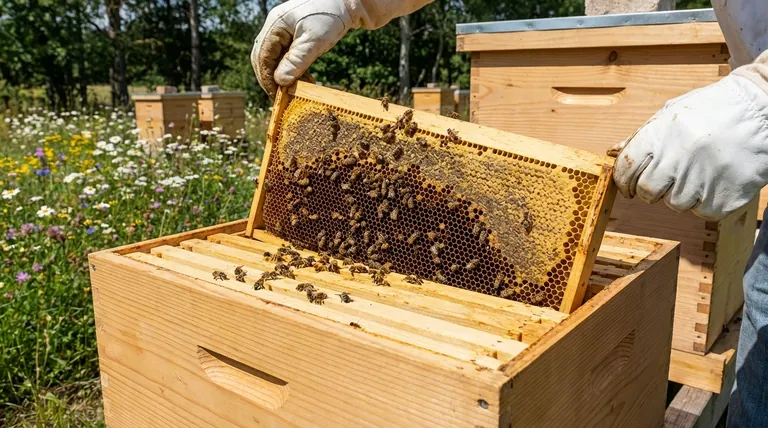
For beekeepers opting for queen excluder-free hive setups, the challenge lies in maximizing brood expansion without sacrificing honey yields or triggering swarms. This guide unpacks the biological mechanisms and practical strategies to achieve this balance—backed by apicultural science and field-tested methods.
The Biology of Unrestricted Brood Expansion
How Brood Frame Availability Impacts Egg-Laying Patterns
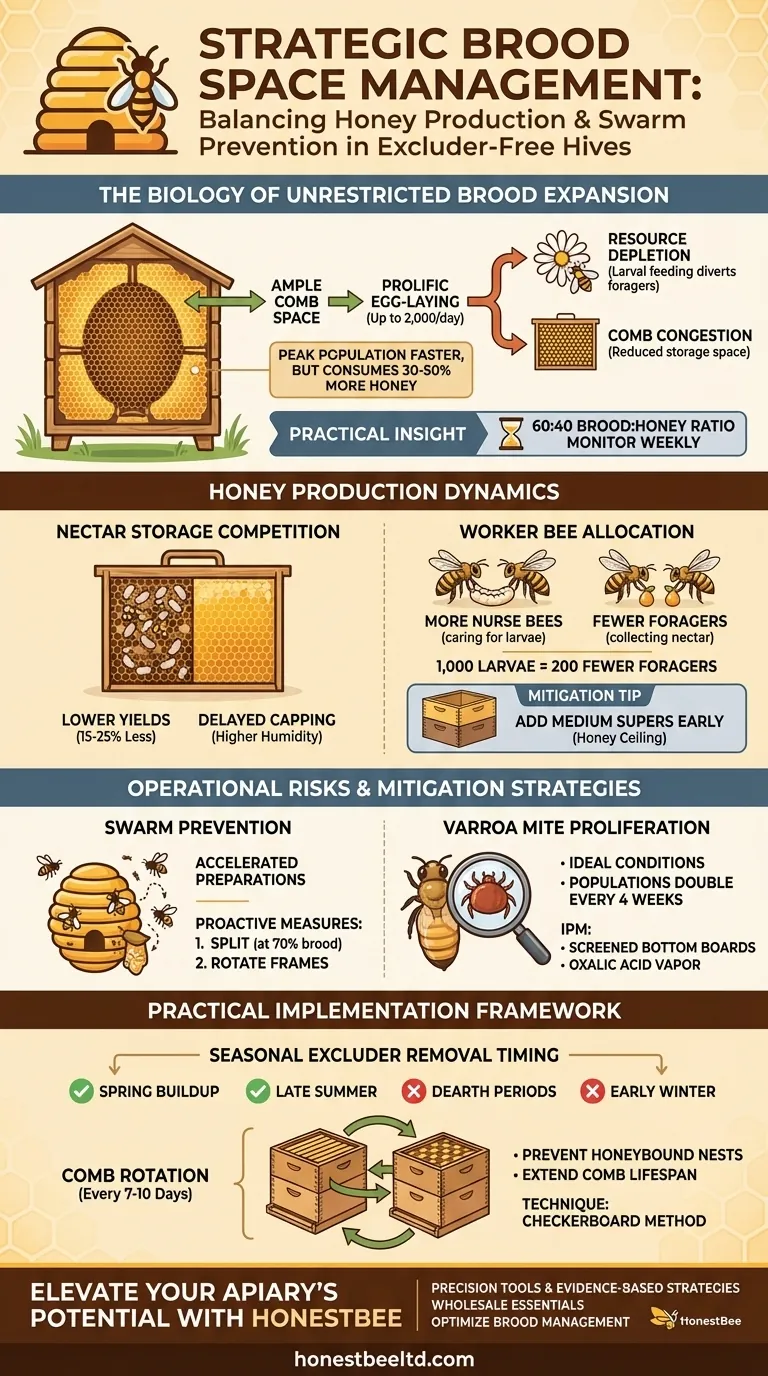
Queen bees exhibit prolific egg-laying in environments with ample comb space. Without excluders, a single queen can lay up to 2,000 eggs daily when brood chambers are unrestricted. However, this unchecked expansion risks:
- Resource depletion: Larvae require constant feeding, diverting worker bees from nectar collection.
- Comb congestion: Dense brood nests reduce space for pollen and honey storage, forcing bees to backfill brood cells with nectar.
The Colony Growth-to-Resource Consumption Ratio
Research shows that colonies with 8–10 deep frames of brood reach peak population faster but consume 30–50% more honey reserves than restricted colonies. Key observations:
- Nurse bees prioritize larval care over foraging during rapid brood surges.
- Overcrowding triggers early swarming, even with abundant floral resources.
Practical Insight: Monitor brood-to-honey frame ratios weekly during peak season. Aim for a 60:40 split (brood:honey) in deep boxes to sustain growth without starvation.
Honey Production Dynamics in Excluder-Free Systems
Nectar Storage Competition in Brood Chambers
When brood expands into honey supers, beekeepers often notice:
- Lower honey yields per hive: 15–25% less compared to excluder-managed hives, as workers store nectar in brood combs.
- Delayed capping: Honey in brood frames takes longer to ripen due to higher humidity from larval respiration.
Worker Bee Allocation Between Nursing and Foraging
Colonies with excessive brood demand more nurse bees, reducing the foraging force. Studies indicate:
- For every 1,000 additional larvae, ~200 fewer bees are available for nectar collection.
- Pollen stores deplete faster, weakening long-term colony health.
Mitigation Tip: Add medium supers above brood chambers early in the nectar flow. This "honey ceiling" discourages workers from storing nectar in brood frames.
Operational Risks and Mitigation Strategies
Swarm Prevention in Overpopulated Colonies
Unrestricted brood space accelerates swarm preparations. Warning signs include:
- Queen cells along frame edges.
- Clustering bees at hive entrances.
Proactive Measures:
- Split before swarms: Divide colonies once brood fills 70% of deep frames.
- Rotate brood frames: Move outer brood frames inward to redistribute heat and slow queen laying.
Varroa Mite Proliferation in Dense Brood Nests
High brood density creates ideal conditions for Varroa destructor. Data suggests:
- Mite populations double every 4 weeks in congested brood nests.
- Untreated colonies collapse within 6–12 months.
Integrated Pest Management (IPM):
- Use screened bottom boards to disrupt mite reproduction cycles.
- Apply oxalic acid vapor during broodless periods.
Practical Implementation Framework
Seasonal Excluder Removal Timing
Remove excluders only when:
✅ Spring buildup: To accelerate population growth before major flows (e.g., clover, citrus).
✅ Late summer: To prepare colonies for winter bee rearing.
Avoid removal during:
❌ Dearth periods: Prevents honey-bound brood chambers.
❌ Early winter: Reduces empty comb that invites pests.
Comb Rotation for Dual-Purpose Frames
Rotate frames every 7–10 days to:
- Prevent honeybound brood nests: Move honey-filled frames to supers.
- Extend comb lifespan: Brood frames used for honey storage accumulate less propolis.
Technique: Use the "checkerboard method"—alternate empty combs with brood frames in the upper box.
Elevate Your Apiary’s Potential with HONESTBEE
Mastering excluder-free beekeeping requires precision tools and evidence-based strategies. HONESTBEE equips commercial apiaries and distributors with wholesale-priced essentials—from durable hive components to mite treatments—ensuring your colonies thrive without compromising productivity.
Ready to optimize your brood management? Explore HONESTBEE’s beekeeping solutions designed for high-yield, sustainable operations.
Note: All strategies are derived from peer-reviewed apiculture studies and field data. Exact metrics may vary based on regional conditions.
Guida Visiva
Prodotti correlati
- Set di numeri di alveare in plastica resistente per l'apicoltura
- Bocchette d'aria ad alveare rotonde in acciaio inox per la ventilazione
- HONESTBEE Soluzione professionale per l'alimentazione delle api dall'alto dell'alveare
- Set di numeri di alveare professionali di grande formato per l'apicoltura
- HONESTBEE Strumento professionale per alveari a manico lungo con lama di taglio di precisione
Articoli correlati
- Termodinamica dell'alveare: l'orologio invisibile che governa la sopravvivenza invernale
- How Beekeepers Can Diagnose Queen Issues and Prevent Colony Collapse
- Il Punto di Svolta: Gestire la Psicologia di un Alveare per Prevenire lo Sciame
- La Fisica della Sopravvivenza: Gestire la Minaccia Invisibile in un Alveare Invernale
- Il Punto di Svolta: Come la Regola del 7/10 Previene il Silenzioso Crollo di un Alveare


















