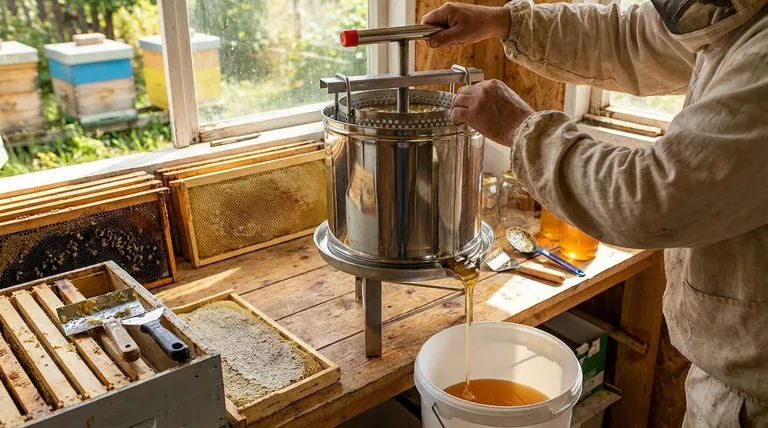
Small-scale honey producers face unique challenges: maintaining food-grade hygiene, optimizing limited workspace, and ensuring equipment longevity. Modern honey screw presses address these pain points through thoughtful material selection and design innovations. Here’s how these solutions translate to real-world benefits for beekeepers.
Honey Processing Challenges in Small Enterprises
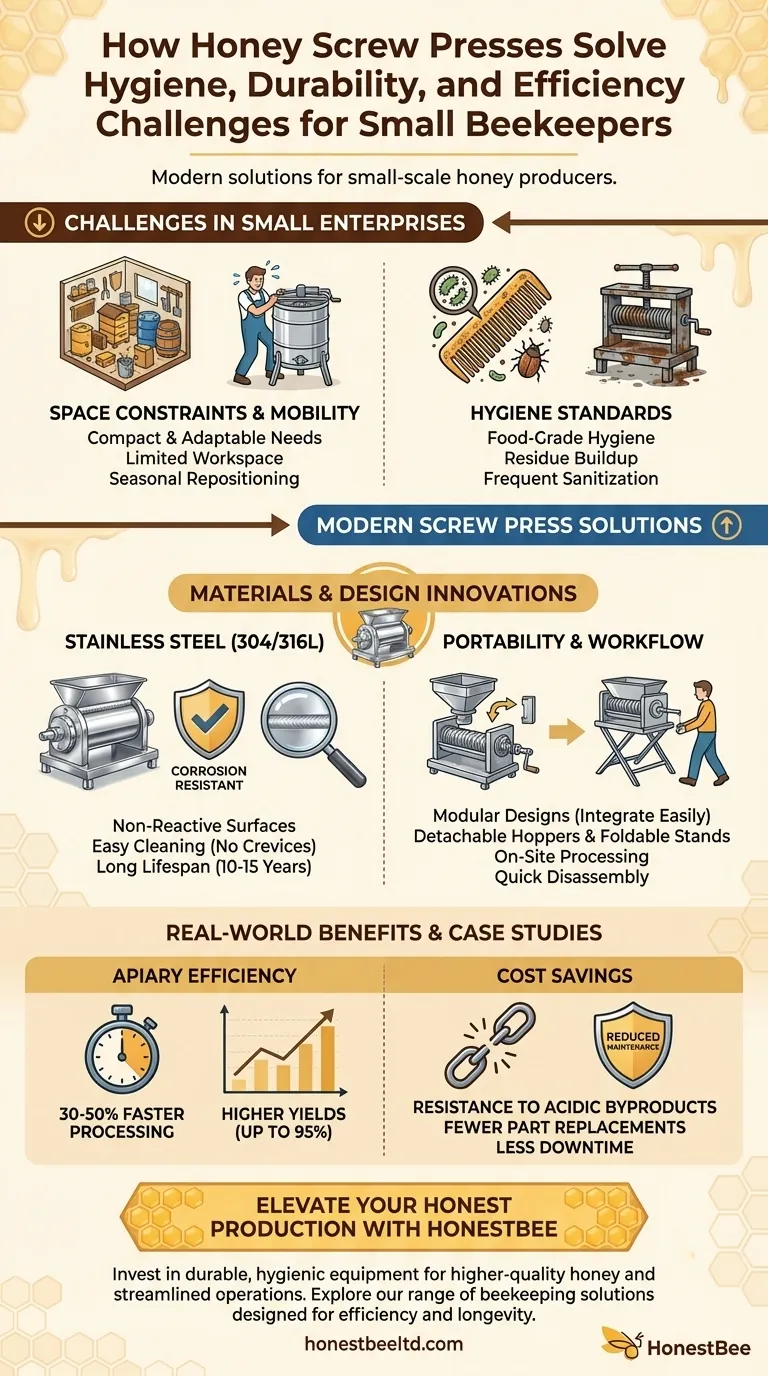
Space Constraints and Mobility Needs
Small apiaries often operate in multipurpose spaces—garages, sheds, or shared facilities—where equipment must be compact and adaptable. Traditional honey extractors can be bulky, requiring dedicated cleaning areas and fixed installations.
Key considerations for space-efficient processing:
- Modular designs allow presses to integrate with existing workflows (e.g., fitting between uncapping tables and storage tanks).
- Lightweight frames enable seasonal repositioning without heavy lifting.
Hygiene Standards in Food-Grade Equipment
Honey’s low water activity reduces microbial risks, but residue buildup in presses can attract pests or compromise flavor. Beekeepers need equipment that:
- Resists bacterial adhesion (common in plastic or porous materials).
- Withstands frequent sanitization without corrosion.
Key Advantages of Modern Screw Press Design
Stainless Steel: Corrosion Resistance and Regulatory Compliance
High-quality screw presses use 304 or 316L stainless steel—materials proven in food processing for:
- Non-reactive surfaces: Prevents metallic contamination of honey.
- Easy cleaning: Smooth welds and polished interiors eliminate crevices where residue accumulates.
Did you know? Stainless steel’s durability reduces replacement cycles, offering a typical lifespan of 10–15 years with proper maintenance.
Portability and Workflow Integration
Innovations like detachable hoppers and foldable stands address small-scale needs:
- On-site processing: Presses can be moved near hives during harvest, minimizing honey transport.
- Quick disassembly: Simplifies cleaning and storage during off-seasons.
Case Studies and Industry Validation
Apiary Efficiency Improvements
Beekeepers using stainless steel screw presses report:
- 30–50% faster processing compared to manual methods, due to continuous-feed mechanisms.
- Reduced waste: Higher extraction yields (up to 95%) from comb honey.
Cost Savings from Reduced Maintenance
Stainless steel’s resistance to acidic honey byproducts (e.g., propolis) lowers long-term costs:
- No need for protective coatings or frequent part replacements.
- Fewer downtime hours for repairs.
Elevate Your Honey Production with HONESTBEE
For commercial apiaries and distributors, investing in durable, hygienic equipment means higher-quality honey and streamlined operations. HONESTBEE’s honey screw presses are engineered to meet the rigorous demands of small-scale processors—combining food-grade safety with beekeeper-friendly design.
Ready to upgrade your honey processing? Explore HONESTBEE’s range of beekeeping solutions designed for efficiency and longevity.
Guida Visiva
Prodotti correlati
- Miele cera separazione cera stampa con macchina di cera separatore vite metallo
- Pompa di trasporto del miele Pompa di miele a vite per liquidi viscosi
- Pressa per miele manuale in acciaio inox con protezione per la spremitura di miele e cera
- Pressa manuale per miele in acciaio inox di facile uso per il pettine di miele
- Miele in acciaio inox stampa cera con serbatoio
Articoli correlati
- Più che calore: la fisica per preservare l'anima del miele
- Come le presse a vite per miele consentono di ottenere rese più elevate con meno scarti
- Scaling Honey Production: Industrial Pressing vs Traditional Extraction for Commercial Apiaries
- Perché le tue etichette per il miele minano il tuo marchio e come risolverlo in modo permanente
- L'ultimo momento di fiducia: perché l'etichettatura del miele è più di un adesivo














